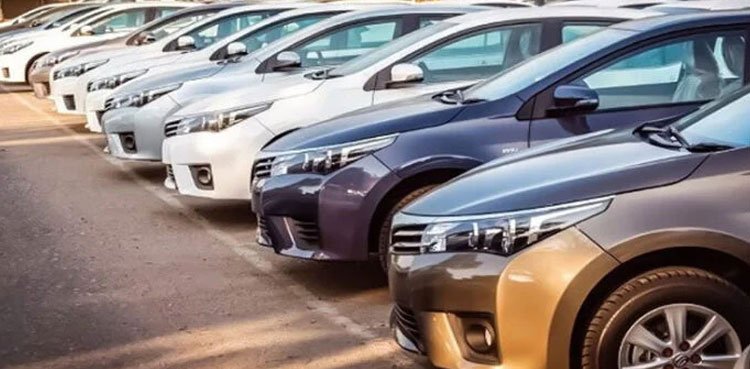
ISLAMABAD: Pakistan now stands as the only auto-manufacturing country in Asia where used vehicles dominate a significant portion of the market — accounting for nearly 25 per cent of domestic sales between December 2024 and December 2025.
Data compiled for December 2024 to October 2025 indicates a sharp resurgence of used-vehicle imports. In comparison, the share of used cars remains negligible in regional peers: India maintains virtually zero used-car inflows, Vietnam stands at 0.3pc and Thailand at 1.2pc.
Industry analysts say the contrast underscores a clear policy divergence. While regional economies have restricted used-car imports to safeguard their automotive value chains, Pakistan has charted the opposite course — especially after Notification 1895 issued by the Ministry of Commerce on Sept 30, 2025, which allowed imports of vehicles up to five years old. After June 2026, this limit may reportedly be removed entirely, potentially opening the floodgates for large-scale inflows of aged vehicles.
Pakistan’s auto sector currently comprises roughly 1,200 factories, provides 2.5 million jobs, generates an estimated Rs500 billion annually in government revenue and holds approximately $5 billion in foreign investment.
“Import-friendly policies risk diluting these gains at a time when industrial revival and localisation are declared priorities,” said Shehryar Qadir, Senior Vice Chairman, Pakistan Association of Automotive Parts & Accessories Manufacturers (PAAPAM).
Of the 45,758 vehicles imported into Pakistan during the period (Dec 2024–Dec 2025), nearly 99pc originated from Japan — a right-hand-drive market compatible with local driving conditions. The remaining numbers were negligible: 130 units from Thailand, 55 from the US, 49 from Jamaica, 47 from Germany, 22 from Australia, 20 from China and just 5 from the UAE.
Former PAAPAM chairman Abdul Rehman Aziz noted the lack of coordination between SBP, FBR and provincial excise departments, citing cases where vehicles are imported under one individual’s name but registered under another. “Ninety-nine per cent of used imports go straight from the port to auto showrooms without any proof of usage period, defeating the purpose of supporting overseas Pakistanis,” he said.
Industry estimates put the loss faced by local vendor industries at roughly Rs50 billion over the analysed period.
The foreign-exchange impact is similarly pronounced: local manufacturers require about $10,138 in documented banking-channel imports per vehicle, whereas used-car importers draw an estimated $14,010 per unit — much of it through informal channels.
While the government is drafting a new Auto Policy to strengthen domestic manufacturing, stakeholders remain split on whether localisation efforts can succeed alongside a liberal used-car import regime. The data suggests that Pakistan is an outlier among manufacturing economies — both in policy direction and market outcome.
Analysts now argue that the core question before policymakers is not whether imports should exist, but what proportion they should hold — and whether the current trajectory aligns with the country’s industrial, employment and fiscal objectives.